Mulde D: Small former opencast mine

Lignite outcrop in the former "Babina" pit

Site Description

Upwards compression of the Muskauer Faltenbogen brought deeper rock strata and brown coal to the surface, where it remains visible to this day. This coal was mined in the Faltenbogen in the period from 1843 until 1973. The Babina pit in Poland, with its small opencast mine Mulde D, was the last to be shut down. The Mulde D opencast mine was functional only in the second half of the 1960s. In the present day, the residual pit is filled with water. The mined object was the major 2nd Miocene Seam Complex (2. MFK, according to its German initials), the upper portion of which stretches over a length of approximately 400 m at this location. As a result of heavy acidification of the subsurface, no new soil or vegetation has yet formed, 40 years after the completion of mining activity.

Data

Locality

Německo

Terrain difficulty

2 / 5

Time required

0.5 hours.

Elevation difference

135 m

What will you see here?

Mulde

1

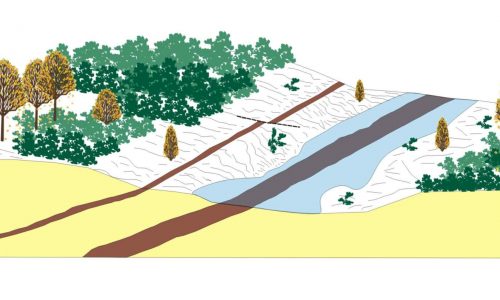
Block diagram of the coal seam.
Mulde

2

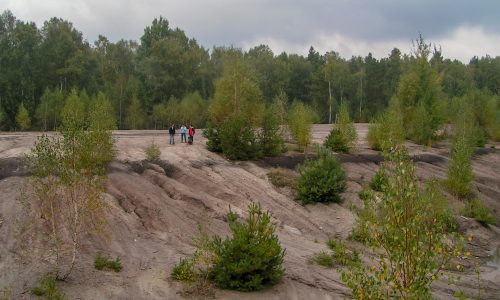
In Pit D of the former "Babina" mine, the outcropping coal seam can be observed to this day.
Mulde

3

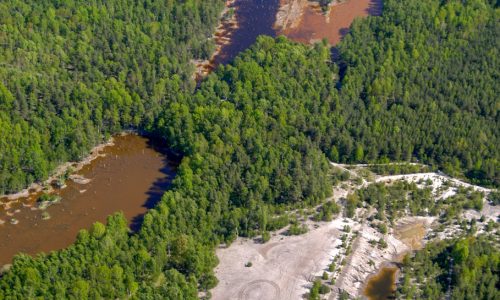
Aerial view of Pit D. Only a small number of pine and birch trees have so far succeeded in colonising the zone.
Do you know that...

Did you know that the Babina is the largest and most significant lignite mine in the Polish part of the Muskauer Faltenbogen? From 1945 until its closure, it was given the name “”Przyjazn Narodow”, or “fraternity of peoples” in English

For Curious Minds

Zatím tu nic není.

How to Reach Us

The site can be accessed via three routes, each entrance with a car park of a different size. The largest, from Przewoźniki (51.541526, 14.777973), the intermediate-sized from Łęknica (51.535186, 14.751870) and the smallest from Nowe Czaple (51.548520, 14.774592).

Site Photo Gallery

DISCOVER OTHER GEOPARK SITES

Each place is unique and hides many layers. Come with us and explore the restored wilderness area.